Foreign transaction fees: what they are and how to avoid them
A foreign transaction fee can quietly add up to 3% to purchases made abroad or with foreign merchants online. The easiest way to avoid it is to know which card to use before you pay.
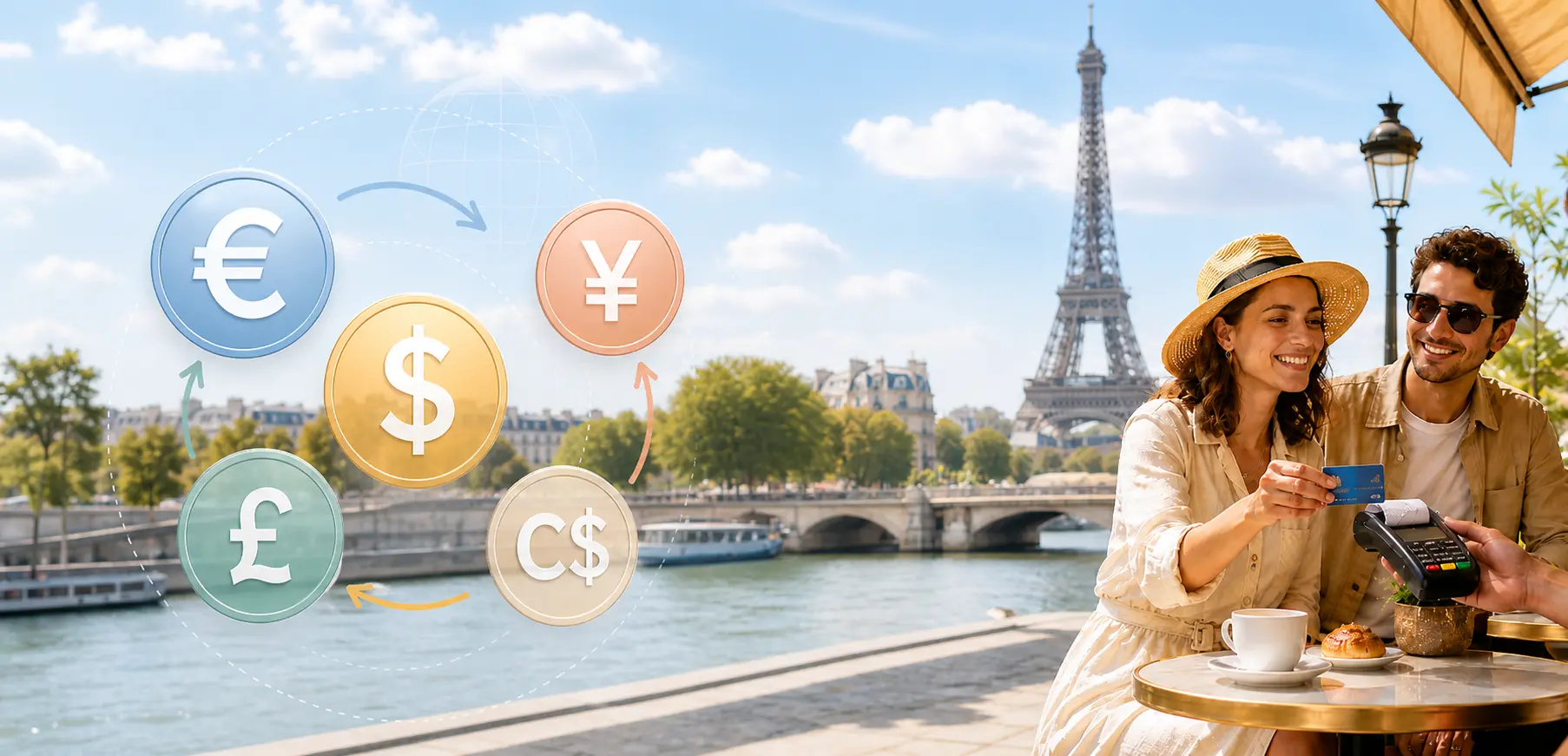
Foreign transaction fees are easy to overlook because they usually do not appear at the moment you pay. You buy a meal, book a hotel, reserve a train ticket, or shop from an international website. Later, when the transaction posts to your statement, the final cost is slightly higher than expected.
That small difference matters. A 3% fee may not sound serious on one purchase, but it can add up quickly over the course of a trip or repeated international purchases.
The good news: foreign transaction fees are avoidable.
What is a foreign transaction fee?
A foreign transaction fee is a charge that some card issuers add when a purchase is processed outside the US or through a foreign merchant. It is calculated as a percentage of the purchase amount.
This fee can apply in two common situations:
- You use your card while traveling outside the US
- You buy something online from a merchant based outside the US
The second situation surprises many people. You do not have to leave the country to trigger a foreign transaction fee. If the merchant processes the payment through a non-US bank or foreign payment network, your card may treat the purchase as foreign.
A foreign transaction fee is not a penalty and not interest. It is a transaction fee charged because of how and where the purchase is processed.
How much do foreign transaction fees cost?
Foreign transaction fees can add up to 3% of the purchase amount. In the US, 3% is common on cards that charge the fee.
Here is what that looks like:
| Purchase amount | Foreign transaction fee | Extra cost |
|---|---|---|
| $50 | 3% | $1.50 |
| $500 | 3% | $15 |
| $2,000 | 3% | $60 |
| $5,000 | 3% | $150 |
The math is straightforward: multiply the purchase amount by the fee percentage to find the extra cost. A $500 hotel charge on a card with a 3% foreign transaction fee adds $15 to the total — silently, and only visible once the charge posts to your statement.
Foreign transaction fees vs. currency conversion fees
A foreign transaction fee and a currency conversion fee are related, but they are not the same thing.
A foreign transaction fee is charged by your card issuer when the purchase is processed as a foreign transaction.
A currency conversion fee can appear when a merchant or payment terminal offers to convert the purchase into US dollars for you at checkout. This is often called dynamic currency conversion.
When you are abroad, a payment terminal may ask:
- Pay in local currency
- Pay in US dollars
In most cases, choose the local currency. Paying in US dollars may feel simpler because you see a familiar amount, but the conversion rate is often worse than the rate used by your card network. Card networks like Visa, Mastercard, American Express, and Discover convert foreign purchases into US dollars using their own exchange rates, which are usually more favorable than what a merchant's payment terminal offers.
When a card terminal abroad asks whether you want to pay in US dollars or the local currency, choose the local currency. Dynamic currency conversion rates are set by the merchant — not your card network — and are almost always less favorable.
Do all cards charge foreign transaction fees?
No. Some cards charge foreign transaction fees, and some do not. Travel rewards cards — including airline cards, hotel cards, and general travel cards — often waive them, but the fee should still be confirmed before you rely on the card abroad. Cash back cards, store cards, student cards, and even some cards from major issuers may still charge foreign transaction fees.
The fee is listed in the card's rates and fees disclosure, often in the same section that shows the APR, annual fee, late payment fee, and balance transfer fee. It is usually labeled "Foreign Transaction Fee". Before traveling or using a card with an international merchant, check that disclosure.
To find the foreign transaction fee for any card you own, look up the card's rates and fees disclosure — sometimes called the Schumer Box. Find the row labeled "Foreign Transaction Fee". If it reads "$0" or "None," the card will not charge this fee on international purchases.
Common foreign transaction fees by issuer
Foreign transaction fees are ultimately card-specific, so always check the exact rates and fees disclosure for your card. Still, many major US issuers follow common patterns:
| Issuer | Common foreign transaction fee | Important note |
|---|---|---|
| American Express | 2.7% | Some Amex travel cards have no foreign transaction fee |
| Bank of America | 3% | Several travel cards waive the fee |
| Barclays | 3% | Many airline and travel cards waive the fee |
| Capital One | 0% | US-issued Capital One credit cards do not charge foreign transaction fees |
| Chase | 3% | Sapphire, United, Hyatt, and other travel cards often waive the fee |
| Citi | 3% | Several travel, Costco, and AAdvantage cards waive the fee |
| Discover | 0% | Discover cards have no foreign transaction fee |
| U.S. Bank | Up to 3% | Some travel cards have no foreign transaction fee |
| Wells Fargo | 3% | Some Wells Fargo travel cards may waive the fee |
Use this table as a starting point, not a substitute for your card's terms. The same issuer may offer one card with a 3% fee and another card with no foreign transaction fee.
Online purchases can count too
Foreign transaction fees are not only a travel issue. They can apply when shopping online from a non-US merchant, even if the website shows prices in US dollars.
Examples may include:
- Booking a hotel or tour directly with a foreign company
- Buying train tickets from an overseas transit website
- Shopping from an international retailer
- Paying a foreign subscription service
- Purchasing event tickets from a non-US seller
If the merchant is outside the US, check your card before paying.
ATM fees are different
Foreign ATM fees are separate from foreign transaction fees. If you withdraw cash outside the US, you may face several possible charges:
- An out-of-network ATM fee from your bank
- A fee from the ATM operator
- A foreign transaction or currency conversion fee on the withdrawal
- An unfavorable exchange rate if the ATM offers to convert the amount into US dollars
Avoid using a credit card to withdraw cash from an ATM abroad. Credit card cash advances typically carry a separate cash advance APR — often higher than the regular purchase rate — and interest begins accruing immediately, with no grace period.
This is why cash is not automatically cheaper. Carrying some local currency can be useful, but repeated ATM withdrawals can become expensive if your bank account is not designed for international travel.
How to avoid foreign transaction fees
The easiest way to avoid foreign transaction fees is to use a card that does not charge them.
Before a trip, check every card you plan to carry. Ideally, bring at least one credit card with no foreign transaction fees and one backup card in case the first card is declined, lost, or not accepted.
You can also reduce avoidable costs by following a few rules:
- Use a no-foreign-transaction-fee card for international purchases
- Choose the local currency when paying abroad
- Avoid using a credit card for ATM cash advances
- Check whether your debit card or checking account charges international ATM fees
- Notify your issuer of travel plans if your card still recommends it
- Carry a small amount of cash for places that do not accept cards
Check every card in your wallet before your next trip.
Pull up the rates and fees disclosure for each card you carry — or call the number on the back and ask. Look for the row labeled "Foreign Transaction Fee". Make a note of which card is your go-to for international purchases. If none of your current cards waive the fee, a no-foreign-transaction-fee card is worth considering — many waive the fee even with no annual fee, so the bar is not as high as it may seem.
When a card with the fee may still be okay
A foreign transaction fee does not mean a card is bad. It means the card is not ideal for foreign purchases.
For example, a card may offer strong cash back on groceries or gas in the US, but still charge 3% on international transactions. In that case, you might continue using it at home while switching to a different card when traveling or shopping with foreign merchants.
- May earn strong rewards on domestic categories like groceries, gas, or dining that you value every day
- Could offer perks — purchase protection, extended warranty, or cell phone coverage — useful at home
- Keeping the card open can support your credit history and available credit limit
- Adds 3% to every international purchase — $60 extra on a $2,000 trip spend
- Does not become a travel card simply because you bring it abroad
- The fee is not always visible at checkout and may only appear once the charge posts to your statement
The mistake is not owning a card with a foreign transaction fee. The mistake is using that card for the wrong purchase.
What to check before you travel
Before an international trip, review this checklist:
-
01
Check your card terms
Confirm which of your cards charge foreign transaction fees and which do not.
-
02
Choose your primary travel card
Use a card with no foreign transaction fees for hotels, restaurants, transportation, tours, and online bookings with foreign merchants.
-
03
Bring a backup
Carry a second card in case the first card is not accepted or is temporarily blocked by the issuer.
-
04
Plan for cash carefully
Check your debit card and bank account terms before using foreign ATMs, because ATM fees are separate from card purchase fees.
Foreign transaction fees are avoidable, but only if you know which card to use before you pay. A card charging 3% adds $60 to a $2,000 trip spend — quietly, and only visible once the charge posts. Use a card with no foreign transaction fees for international purchases, always choose the local currency at checkout, and always travel with a backup card in case the first is declined or not accepted.